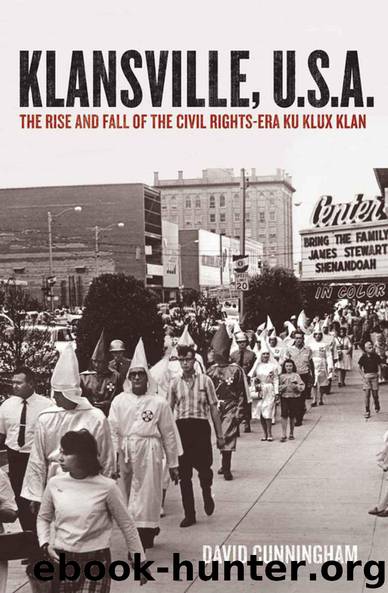
Klansville, U.S.A:The Rise and Fall of the Civil Rights-era Ku Klux Klan by Cunningham David
Author:Cunningham, David [Cunningham, David]
Language: eng
Format: epub
Publisher: Oxford University Press
Published: 2012-09-25T06:00:00+00:00
Charlotte
Though only an hour and a half car ride from Greensboro, Charlotte’s reputation in terms of race relations seemed at times a world apart. In 1963, while some of the largest mass demonstrations of the civil rights era played out in Greensboro, Charlotte’s pioneering approach to desegregation received national attention. “As we have accumulated information about changes in racial practices around the Country,” Attorney General Robert Kennedy wrote that June, “we have been particularly impressed by the striking progress which has been made in Charlotte.” He credited the city’s residents, and especially its “business, social and political leadership,” as he promoted Charlotte as a regional model. “It is our hope,” Kennedy concluded, “that those who have led and contributed to break-throughs such as Charlotte’s will find opportunities to share their experiences with other communities which are anxious—as we believe by far the greater number are—to work similar changes, and which are confronted with the same initial difficulties as those which you had to overcome.”47
By the end of that year, as accounts of the city’s successes appeared in newspapers around the country, scores of communities struggling with difficulties posed by desegregation would request assistance from Charlotte mayor Stanford Brookshire. In North Carolina, inquiries rolled in from officials in Wilmington, Goldsboro, Kinston, Hickory, Lexington, Mooresville, Wadesboro, and Burlington. The Community Advisory Committee in Jacksonville, Florida, solicited advice in hopes of “profiting from [Charlotte’s] experience.” Similar calls came from communities as diverse as Richmond, Virginia; Little Rock, Arkansas; Omaha, Nebraska; and Jamaica Plain, Massachusetts. Florida’s Dade County Community Relations Board, the Mississippi Council on Human Relations, and the US Conference of Mayors all requested information to guide their respective processes. Brookshire was elected chairman of North Carolina’s Mayors’ Cooperating Committee and reportedly was offered the inaugural directorship of the National Citizens’ Committee for Community Relations. The New York Herald Tribune published his views on race relations, and Brookshire also received the B’nai B’rith Women’s Humanitarian Award, an honorary doctorate from Pfeiffer College, and a silver medallion from the National Council of Christians and Jews. In 1965, the Charlotte News named him its “Man of the Year.”48
As Southern Regional Council information director Pat Watters put it, “Charlotte chose a different way.”49 While in many of the South’s cities integration emerged incrementally following a protracted struggle, Charlotte’s public officials and private business owners agreed to desegregate well in advance of 1964’s Civil Rights Act. Subsequent accolades tended to exaggerate the smoothness of the transition, but Charlotte’s race relations progression contrasted sharply with that of Greensboro. While in both cities elites responded to pressures exerted by civil rights activists, Charlotte instituted reforms more rapidly and completely, and with significantly less public confrontation. And while Greensboro served as the UKA’s de facto Piedmont recruiting center, organized white resistance was minimal in Charlotte, despite a small number of well-publicized spasms of racial violence.
The UKA’s inability to penetrate Charlotte continued a long-standing string of failures by militant white supremacist groups in the city. In September 1957, an incipient Citizens’
Download
This site does not store any files on its server. We only index and link to content provided by other sites. Please contact the content providers to delete copyright contents if any and email us, we'll remove relevant links or contents immediately.
| Anthropology | Archaeology |
| Philosophy | Politics & Government |
| Social Sciences | Sociology |
| Women's Studies |
Nudge - Improving Decisions about Health, Wealth, and Happiness by Thaler Sunstein(7771)
The Fire Next Time by James Baldwin(5537)
iGen by Jean M. Twenge(5475)
Adulting by Kelly Williams Brown(4638)
The Sports Rules Book by Human Kinetics(4468)
The Hacking of the American Mind by Robert H. Lustig(4437)
The Ethical Slut by Janet W. Hardy(4315)
Captivate by Vanessa Van Edwards(3880)
Mummy Knew by Lisa James(3736)
In a Sunburned Country by Bill Bryson(3600)
The Worm at the Core by Sheldon Solomon(3531)
Ants Among Elephants by Sujatha Gidla(3500)
The 48 laws of power by Robert Greene & Joost Elffers(3405)
Get What's Yours for Medicare: Maximize Your Coverage, Minimize Your Costs by Philip Moeller(3215)
Suicide: A Study in Sociology by Emile Durkheim(3054)
The Slow Fix: Solve Problems, Work Smarter, and Live Better In a World Addicted to Speed by Carl Honore(3051)
The Tipping Point by Malcolm Gladwell(2980)
Humans of New York by Brandon Stanton(2924)
Handbook of Forensic Sociology and Psychology by Stephen J. Morewitz & Mark L. Goldstein(2753)
